
Procedures
- Laser hemorrhoid surgery (and combined procedures)
- Anal fissure surgery
- Anal fistula surgery (LIFT, VAAFT, laser, seton, plug, etc.)
- Perianal abscess surgery
- Pilonidal sinus surgery (phenol, laser, flap, etc.)
For diseases of the anal region (anorectal diseases), we use modern techniques that put patient comfort first and keep the risk of recurrence as low as possible. Prof. Dr. Hedef Özgün is one of the most experienced laser hemorrhoid surgeons in Türkiye and one of the few doctors in the country who perform Video-Assisted Anal Fistula Treatment (VAAFT).
Laser hemorrhoid surgery
Laser hemorrhoidoplasty is a comfortable, widely preferred method because it means less pain, faster healing and an earlier return to daily life. Since we started laser hemorrhoid surgery in 2015, hundreds of patients have been treated, and almost none have had hemorrhoid problems again.
A key advantage is that laser surgery does not cause complications seen after conventional stitched surgery, such as narrowing (stenosis) or faecal incontinence. It also does not get in the way if surgery in this area is ever needed again.
The procedure takes about 20 minutes and you feel no pain during it. Most patients return to daily life within 2–3 days and to work within 10–15 days. When needed, it is combined with rubber band ligation, hemorrhoidal artery ligation or radiofrequency treatment.
Radiofrequency hemorrhoid treatment
Radiofrequency treatment gives results similar to laser surgery, with similar comfort and recovery. It is quick and also effective for grade 3 and 4 hemorrhoids.
Anal fistula: VAAFT and other techniques
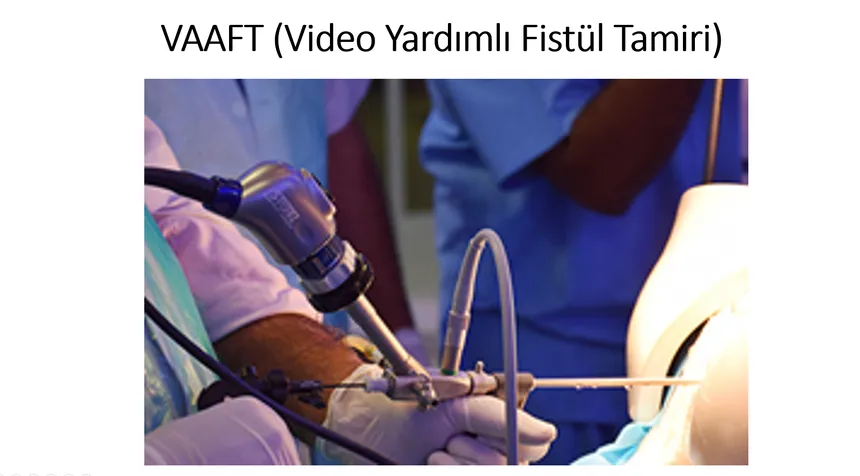
In video-assisted fistula repair, a small camera is passed through the outer opening of the fistula to find the inner opening with a closed technique and to detect any additional tracts. Seeing the problem directly improves the success of treatment. It is also reliable for complex fistulas that run through the sphincter muscle. Performed without a risk of incontinence, VAAFT has one of the highest success rates among fistula operations. Depending on the type of fistula, LIFT, laser, seton or plug techniques are also used.
Anal fissure and anal stenosis
Anal fissure can be treated surgically or with a Botox injection. In anal stenosis, a skin flap is used to widen the anal opening. Anal stenosis often develops after previous stitched hemorrhoid surgery.
Pilonidal sinus
Depending on how extensive the disease is, pilonidal sinus is treated without surgery (phenol, laser) or with surgery (flap techniques).
Frequently asked questions
Is laser hemorrhoid surgery painful?
The procedure is done under anaesthesia, so you feel no pain during it. It takes about 20 minutes. Pain afterwards is clearly less than after conventional stitched surgery, and most patients return to daily life within 2–3 days.
When can I go back to work after laser hemorrhoid surgery?
Most patients return to daily life within 2–3 days and to work within 10–15 days. This depends on the grade of the hemorrhoids and the type of work.
Is there a risk of incontinence with VAAFT?
VAAFT is a closed, sphincter-preserving technique. It is performed without a risk of faecal incontinence and has one of the highest success rates among fistula operations.
The information on this website is for general information only and does not replace an examination or medical advice. Please consult your doctor for diagnosis and treatment.